




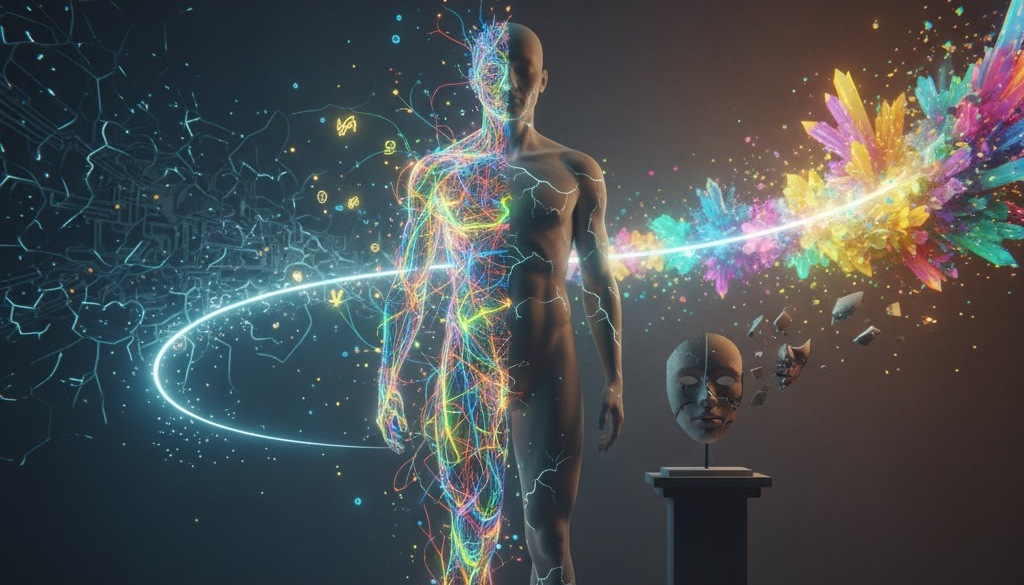
Who Am I Now?
Neurological change doesn’t just alter how the brain functions – it reshapes the sense of self.
When an injury, stroke, or medical event reorganizes neural pathways, the transformation is not merely cognitive.
It is psychological, emotional, relational, and existential.
Many people expect neurological recovery to be mostly physical: learning to walk again, regaining vision, rebuilding stamina, improving memory or speech. But few understand that reconstruction of the self is often the deepest and most confusing part of the journey.
After neurological change, identity is not simply “lost” – it becomes fluid.
Old versions of you may fade. New versions may emerge unexpectedly.
And between them lies a long period of disorientation, grief, and rebuilding.
This experience is not a personal weakness – it is a predictable neuropsychological process.
Why Identity Changes When the Brain Changes
The brain regions most involved in selfhood – the temporal lobes, parietal lobes, insula, prefrontal cortex, and the networks connecting them shape:
- autobiographical memory
- emotional processing
- language and self-expression
- body awareness
- decision making
- social cognition
- personal values and preferences
When networks change, the perspective from which we see ourselves can also change.
For example:
- Injury to the parietal regions can shift body awareness and spatial perception – changing how “inhabited” one’s own body feels.
- Temporal lobe disruptions may alter memory, emotional tone, and even one’s sense of connection to past versions of oneself.
- Frontal network impact can change initiation, energy, personality expression, or emotional boundaries.
- Changes in sensory processing can rewire what feels comfortable, tolerable, overwhelming, or soothing.
When a stroke, lesion, or surgical complication affects these areas, the “internal scaffolding” of identity becomes disrupted. The version of you that existed before the neurological event is suddenly inaccessible in some ways, and your brain begins recalibrating how you think, feel, relate, and understand yourself.
And psychologically, this raises painful questions:
“Who am I now?”
“Who will I become?”
“Will the people I love still recognize me – or want me?”
The Grief That Has No Name
People who experience neurological change often speak of a strange, private grief:
not grief for a person lost, but grief for the version of themselves who existed before the event.
This grief can feel invisible because:
- Others see the physical symptoms but not the identity disruption.
- Loved ones may encourage gratitude (“You survived!”) before acknowledging loss.
- Many survivors feel guilty for missing their “old self”.
- Medical systems rarely address psychological identity reconstruction.
But identity grief is real.
And grieving is not a sign of “not being positive enough”.
It is a sign of being human – of recognizing that something meaningful has changed.
Identity Reconstruction: A Psychological and Emotional Process
Identity after neurological change often moves through phases:
- Disorientation. A sense of strangeness or unfamiliarity with yourself. Your reactions, emotions, or abilities surprise you.
- Awareness. Recognizing what is different – sometimes with grief, sometimes with curiosity, often with both.
- Grieving the “Before-Self”. Acknowledging that some traits, abilities, or mental states may not return exactly as they were.
- Integration. Allowing both loss and possibility to coexist. Experimenting with new ways of thinking, relating, creating, and living.
- Rebirth of the Self. Gradually stepping into a version of yourself that is more informed, more compassionate, and often more authentic than before.
This psychological process is natural – not a failure, not a regression, and not a sign of weakness.
Becoming Someone New: The Reconstruction Phase
Over time – weeks, months, years – the brain continues to reorganize (a process known as neuroplasticity). But the mind also begins a parallel reconstruction:
- Integrating what was lost
- Recognizing what remains
- Discovering what is emerging
Psychologically, this process mirrors post-traumatic growth: a transformation not through toxic positivity, but through honest engagement with pain, limitation, and resilience.
Survivors often describe:
- seeing themselves with greater compassion
- releasing roles they performed automatically before
- prioritizing rest, boundaries, or authenticity
- becoming more aware of their needs and limits
- developing a more grounded, embodied sense of self
- valuing connection over performance
- finding meaning in lived experience, not expectations
Neurological change can strip away layers of identity that were built on habit, pressure, or survival.
What remains can be unexpectedly clearer, truer, and more grounded.
My Own Identity Shift: What I Feared Most
When my brain changed, one of my deepest fears wasn’t just the physical loss or the cognitive disruption.
It was the possibility of abandonment.
I was terrified that in the moment I became vulnerable – unsteady, confused, emotionally raw – the people I loved would no longer recognize me as me.
That they had loved the “previous version” of Nataliya: articulate, competent, fast-thinking, emotionally contained.
Not this new, fragile prototype of a person still humbly discovering who she was becoming.
The physical changes were one thing.
But the identity changes felt far more frightening.
When Language, My Anchor, Slipped Out of My Hands
I speak three languages. Each of them is a home, a lens, a part of my identity.
After the embolization injury to the temporal and parietal regions, language stopped behaving the way it always had.
I experienced a form of arcuate fasciculus and Wernicke-type aphasia:
- my vocabularies blended into one chaotic, multilingual soup
- I searched for the simplest words for minutes at a time
- anomia (word-finding difficulties) made me feel like thoughts dissolved before reaching the surface
- I substituted words without noticing
- grammar and syntax unraveled
- my Spanish, learned as an adult, collapsed into something primitive, fractured, almost childlike, and took years to rebuild
For someone whose identity was deeply anchored in intelligence, articulation, and the ability to express nuance…this was a silent devastation.
I was fully aware of my limitations.
And that awareness – acute, painful, unfiltered – made acceptance even harder.
The cognitive fog caused by the lesion, and the heavy corticosteroid treatment – often called “corticoid dementia” – only deepened the confusion.
I felt trapped inside a self I didn’t recognize.
Who Stayed
Through all of this, only one person accompanied me with unwavering loyalty, tenderness, and presence:
my daughter.
While adults around me grew uncomfortable, distant, or overwhelmed by the slow, raw process of my becoming…
she simply stayed.
Children have a remarkable ability to love without conditions, without nostalgia for who someone used to be. She didn’t need me to be polished or articulate or strong.
She needed me to be there – and I was.
Her presence gave me a sense of continuity when everything else felt fractured.
She reminded me, without words, that I was still worthy of love even when my mind felt broken, reorganizing, rearranging itself into something new.
Becoming Someone New – Without Losing Myself
Today, I understand something I couldn’t see then:
Identity after neurological change is not about becoming “less”.
It is about becoming different – and sometimes, more whole.
A different configuration of the same human being, shaped by:
- vulnerability
- resilience
- neuroplastic adaptation
- the necessity of listening more deeply to one’s own boundaries
- a re-negotiated relationship with time, energy, and purpose
The version of me that grew out of the rupture is slower, softer, more perceptive, more compassionate, and more aligned with what truly matters.
She is still learning. Still adapting. Still expanding.
We do not return to who we were.
But we can grow into someone wiser, kinder, and more authentic than before.
And that, too, is a form of healing.
By Nataliya Popova
Mindly Different – Coaching for the beautifully different mind
 Mindly Different
Leave a comment